
Back when I was a kid time seemed to crawl at an agonising pace. This was likely because before the internet had properly made its way into my household, entertainment was a finite resource, and its supply fell far short of conquering the gargantuan gaps that riddled my childhood schedule. So when it came to creating ways to pass the time, I became a master of the medium. I would sketch, write, and play with anything I could get my hands on. I frequently had action-figure level adventures with a loose handful of change which was intended by my parents to be spent on snacks. As I got older this habit of restlessly searching for distractions followed me.
The gaps in my days don’t loom as large anymore, but a deluge of short-form endlessly-scrolling media seems to hunger for even my most fleeting moments. While my old attempts to crush boredom with a handful of coins and some imagination may seem strange in retrospect, they still feel preferable to the content I find myself reluctantly addicted to. I began to realize the severity of my current situation while investigating my habits, and asking myself the following question:
“Is this guilty pleasure even pleasurable?”
My intent in writing this is not to shame anyone for falling into lazy habits, my aim is instead to suggest an alternative way to waste your time. This particular essay is the results of what I will generously refer to as an experiment, despite an incredibly lax attitude towards the scientific method. I’ll first give a short bit of background to help you understand why I chose the approach I did, after which I shall briefly sum up the rules I gave myself.
The ‘Experiment’
This will certainly not wind up on Google Scholar or survive peer review, but I do hope that both you and I gain something from my little endeavour. Over the course of a month, I took one of my four portable consoles everywhere I went for a week. Whenever I felt compelled to aimlessly use my phone I instead played a game on my device that suited the amount of time I intended to waste. Waiting briefly for something to finish cooking was perfect for an arcade title such as Tetris, whereas a lengthy commute was better utilised by a tactical RPG such as Tactics Ogre. The consoles in my rotation were: the Game Boy Pocket and Colour (given that they share a generation), the PlayStation Portable, the Nintendo DS, and the PlayStation Vita. Though I’ve explained all the details of the experiment, I think it’s worth giving a little justification as to why I chose this particular medium.
I implied earlier that it was the internet’s arrival that revolutionised my time-wasting strategies, when a different technology was actually responsible. The portable console. When I was around eight years old I received a Game Boy Pocket as a hand-me-down from my mother. It may seem a primitive tool now, but you must understand that it felt impossibly powerful in comparison to the $3.25 I was playing with prior. A self-contained gaming device, which you could take with you wherever you go! How could I not fall in love with the very concept? Birthdays would often introduce me to more of these joyful machines, providing years of satisfaction, until adulthood and independent living saw me transition away from the portable and towards a stationary gaming computer, for more hardware-intensive experiences.
One day, after feeling a significant amount of shame at how long I had been scrolling mindless content for, I dug out my mother’s old Game Boy Pocket with its Pokemon Red cartridge already slotted in, and decided that I would bring this everywhere I went for the day. Whenever I found myself itching to stare at my phone for no particular reason, instead of idly scrolling social media I would take down a gym leader or fill out a few more entries in my pokedex. Much to my surprise, the experience was fantastic. Rather than wasting time drowning in a sea murky with ads and slop, I was getting the satisfaction of beating brief challenges that I knew actually progressed towards completion. Because of how much I enjoyed this feeling, I decided to expand upon this trial, and see what lessons I could learn from these old but unforgotten time-wasting champions.
Simple lessons from old teachers
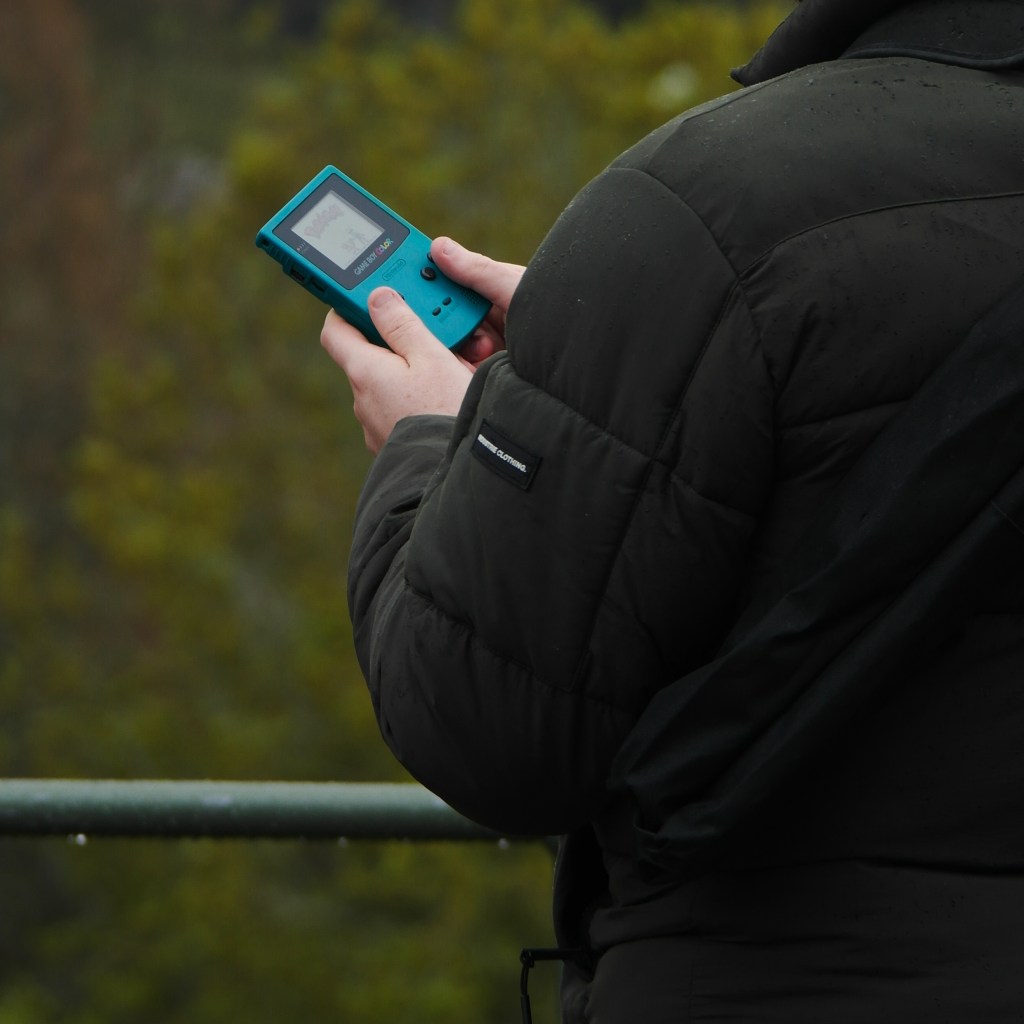
The Game Boy & Game Boy Colour
You would’ve found me…
Aimlessly walking around local suburbs, playing Kirby’s Star Stacker, Pokemon Red, and Wario Land 3
A common criticism of the Game Boy is that its screen lacks any form of backlighting, and thus is rendered useless when in a poorly lit environment. Many children who spent time with it will have ancient backseat memories of street lamps being their only intermittent source of light on long drives. This made upgrades and accessories for the screen an incredibly popular project for portable hobbyists in the modern day, yet I’ve kept mine as is.
While I’m sure its designer, Gunpei Yokoi, was limited by the cost, size, and technology of the time, I can’t help but think that maybe this screen was an intentional design choice. Much like how Shigeru Miyamoto suggested that the first Pokemon game should be split into two complementary titles, keeping exclusive creatures in each edition to promote sharing and community within its players. I wonder if perhaps this unilluminated screen suggests that its users still enjoy the world outside of it, and set it down as the sun does the same. Interestingly, the Game Boy’s screen actually works at its best in full sunshine, almost prompting its players to spontaneously leave their stale rooms and get some fresh air. But not to leave play behind in the process.
Playfulness has no borders

The PlayStation Portable
You would’ve found me…
Grinning on my lunch break, playing Dragon Ball Tenkaichi Tag Team, Unlosing Ranger Vs Darkdeath Evilman, and Capcom Classics Remixed
While home to games that varied greatly in style and format, there was a commonality I noticed in the titles I most enjoyed. I always seemed to finish my little play session satiated, not hesitating to put my device down like I might for my phone. This could be because I had just beaten a particularly hard challenge, but more often I simply felt I had enjoyed my fill. My theory is that perhaps, since auto-saving was still in its infancy and an infrequently implemented feature, that seasoned developers designed their games with satisfying off-ramps in mind. Forgive my borrowing of freeway terminology, but I feel its an apt metaphor for this particular design choice. In contrast to the mild hostage situation that emerges from an endless-scroll of auto-playing videos, these games were like highways you could lose yourself in, feeling safe in knowing that a satisfying exit is never far away.
This generation of consoles did also introduce the sleep function, a now ubiquitous feature in modern technology. While it calms your mind about the possibility of losing progress, have you ever felt satisfied stopping a film halfway through? I still preferred properly saving and quitting, tying a neat ribbon on my little affair. Not every title had a floating floppy disk slowly rotating above a glowing circle, but throughout so much of the PlayStation Portable’s library are titles that respect your time. Fighting games with ninety second matches, sports cars drifting for three short laps, and arcade revivals which task you with playing for as long as you can. But only for as long as you want to.
Respect your own time
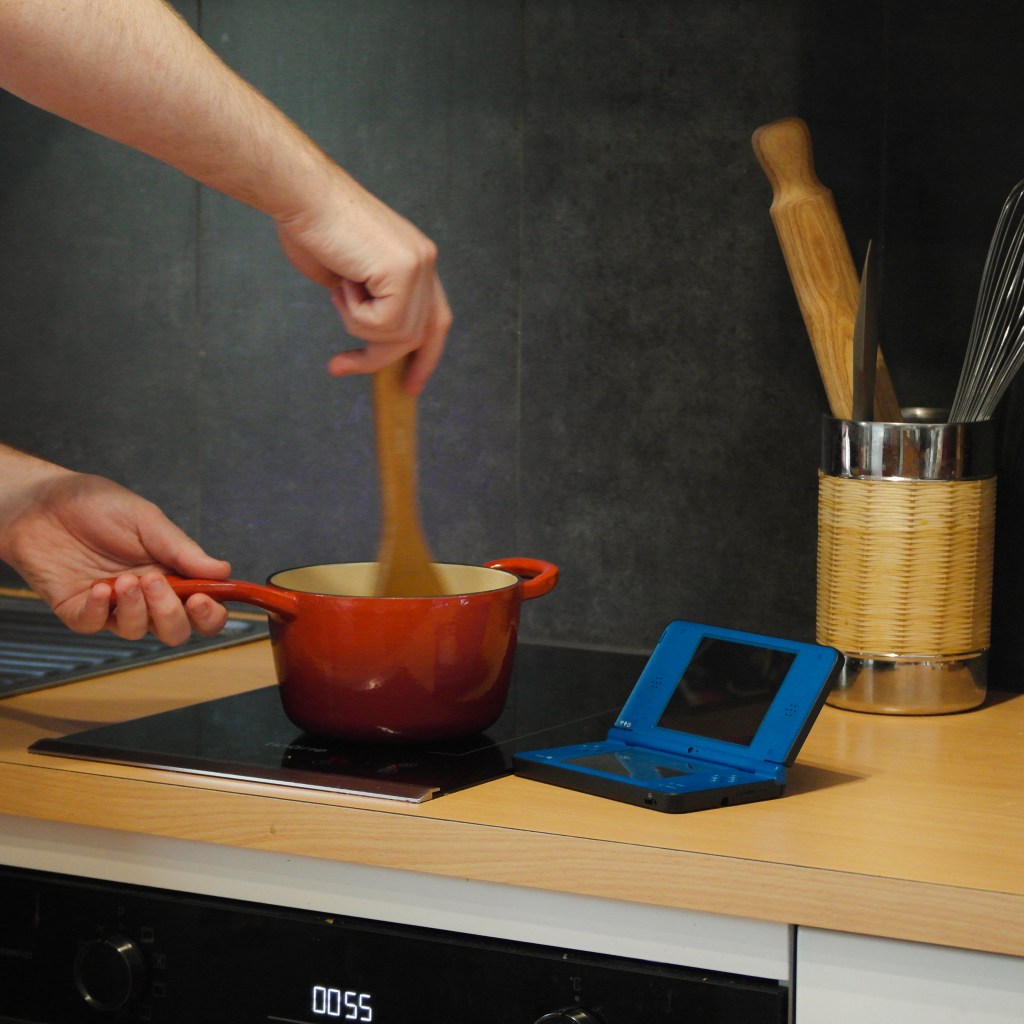
The Nintendo DS
You would’ve found me…
Dreary-eyed in bed, playing Pokemon Conquest, Mario Kart DS, and Aliens Infestation
Admittedly, this is the console I played the least during its week. My reason being that when I was growing up the Nintendo DS was by far the most popular portable around. I have such a familiarity and fondness for its catalogue that I felt I didn’t need to retread that ground. Every major series seemed to have some amazing representation on this console. But that leads me to the lesson I learnt when I did finally pick it up and peruse its expansive library. As someone who spent a wealth of time with the DS, long past the introduction of its successor, I was stunned by the quantity and quality of titles which I had never heard played, let alone even heard of.
There’s a lot that makes games designed for portable consoles unique. Visuals are the most obvious, as fitting all of this hardware and the accompanying batteries into a palm-sized unit necessitates some graphical limitations. A less apparent aspect is that due to their emphasis on portability (and awareness of the battery’s capacity) titles are generally designed to either be played in short bursts, or with many opportunities to conclude your experience. The limited physical controls alone would make developers reconsider how complex they could make their systems. Imagine trying to design an in-depth civilisation-management game for a console with two buttons and a directional pad. I mention these factors as I believe they are why many of these titles are lost to time, seen as not being worth ported to modern hardware. There are exceptions of course. Great examples being Nintendo’s expanded remake of the Game Boy classic Link’s Awakening for the Switch, or Konami’s more faithfully ported Castlevania Advance and Dominus collections. But while these particular games survived, thanks in part to their design and popularity, there are hundreds more which were masters of their niche mediums, yet will likely remain buried in the past.
This is a lesson I learned from every portable I played during this experiment, but particularly from this console which I thought I had so thoroughly explored. There is a wealth of hidden gems for you to discover, buried in the sands of time, which are as enjoyable now as they were then.
The past is worth exploring

The PlayStation Vita
You would’ve found me…
Surviving long dull train rides, playing Sound Shapes, Bastion, and Dragon’s Crown
The PlayStation Vita was made to be the most powerful portable console at the peak of the portable craze. It was stocked with impressive hardware, multimedia capability, and even backwards compatibility with it’s ancestors, the PSP and PS1. Yet, it’s generational competitor, Nintendo’s 3DS, outsold it nearly sevenfold. Why is that? I believe it’s because the Vita was PlayStation’s own Icarus, flying too close to the sun.
My time with the other three devices was as educational as it was enjoyable, but the Vita’s week felt different. I slogged through a handful of bloated games, filled with muddy textures, struggling to operate, and evoking a hollowness that contrasted the sincerity that flooded out of it’s predecessors. I felt I had witnessed what started the abrupt death of the portable era. A console bulging with potential yet starved for first-party titles due to the cost to develop for it.
My week might have been a disappointment, if not for the small handful of AAA games which were actually superb, and for the Vita’s true saving grace, the indie scene. It’s form factor, hardware, and its portable nature in particular made it a perfect match for indie developers, whose games typically are on the shorter or smaller side. My final lesson was similarly short and sweet. Lean perfection is preferable to a swollen mess.
You are allowed to enjoy your niche
The new kids on the block
If you don’t mind me hopping on a soapbox to bark my opinions briefly, I’ll tell you what I think of the modern portable options. The Nintendo Switch may literally be a portable console, but when everyone primarily plays it docked at home or on a couch in front of the same TV, I don’t think it really counts. Similar to the point I was trying to make with the Vita, I don’t believe that the Switch has portable games, I believe it’s library is built up of console games that happen to be on a portable console. Personally I see it as a different design ethos, and not just whether or not the device needs to be plugged into a wall to operate.
I don’t see the Windows handhelds that are currently booming in popularity as portable consoles either. In my eyes they are simply a reshuffled form factor of a gaming laptop. Not that that is inherently bad, I do love having a better portable platform for modern indie games that feel too small or simple to boot up my computer for. My issue is that their immense size and power draw lead to you not taking these out of the house, for fear of theft as much as emptying the battery. What is the point of a console being portable if it feels tethered to your house.
Lastly, the emulation handhelds that you see being released in new models week after week. My thoughts are simple, I’m glad that you are able to play titles on hardware that is similar in form factor and control scheme to the originals. But being able to run anything and everything on the one device simply leads to the paradox of choice commanding you to leave it on the shelf.
My suggestion for you
Thanks for indulging me up until this point, I sincerely appreciate you taking the time to read this. I’d like to try and briefly sum up my thoughts after this whole experiment in some form of a basic suggestion for you.
If you’re someone who has fond memories of any of these devices, I can heartily recommend picking one up again. Even if you haven’t had experience with one of these before, but you have found yourself bored with the lacklustre game design of the mobile app store, give this a try and see how developers of the past would have catered to you. In fact, if you’re interested in picking up one of the Game Boys I’d almost say it’s more fun to pick up a dinged and bruised one. They’re remarkably easy to reshell, and there’s a myriad of fun upgrades available online if you’re the type who likes to fiddle with simple electronics and wants an easy passion project.
As long as you’re excited to play one of these, I know it’ll be worth it for you. Play your old favourites, play something you’ve never heard of before, just play for play’s sake. In our lives there are countless tasks that we should be performing at any given time, there’s always chores we’re putting off, messages we’re not replying to. But imagine that next time you feel that need for a mental break, instead of just staring at a unending scroll of things you don’t care about, you’re instead confusedly trying to decipher the rules to a Japanese-language Kirby Tetris game that came bundled with your Game Boy Colour. Okay, for one that’s probably too specific and personal of an example, and two, it might only be me that would enjoy that situation. But let yourself play regardless, allow yourself to consciously relax and do what you actually enjoy. Life’s hard, you at least deserve rest that is satisfying.



 BEEEMEM'S HIVE
Leave a comment