

2-6 Players, 15-25 Minutes
Quick silly fun, a fantastic warm-up before a bigger game or after dinner.
The benefits of lying to your friends and family
Social deception and bluffing games can be a sore spot for a lot of people because of the social stress they add to an already competitive situation. As something of a pathological liar myself, I have no such qualms.
If anything I think barely being able to hold a poker-face while spouting nonsense is an underrated comedic benefit of playing games face-to-face with your close friends. After all it’s the people who you feel comfortable enough to let your guard down around who have learned and accepted all of your quirks and ticks. It’s only fair to weaponise that for an evening of hilarity.
To feel like you understand someone so well that your communication is borderline telepathic, is to also realise the depth of your connection with that person. When I give a long-winded explanation of how I am utterly and unshakably sure that you are lying, I am also admitting how accustomed I am to your company and antics. I mean, I saw your eyebrow flinch when I said Frog after all. J’accuse!
But, it’s no crime to be wrong either! With the tension threatening to boil over, all eyes on the pair of us as you reveal the truth. That the aforementioned flinch was just a stifled sneeze. Accusatory fingers succumb to gravity and descend as the table erupts in laughter. Regardless of how well you think you know someone, they will always relish the opportunity to surprise you.
That’s what these games are to me.
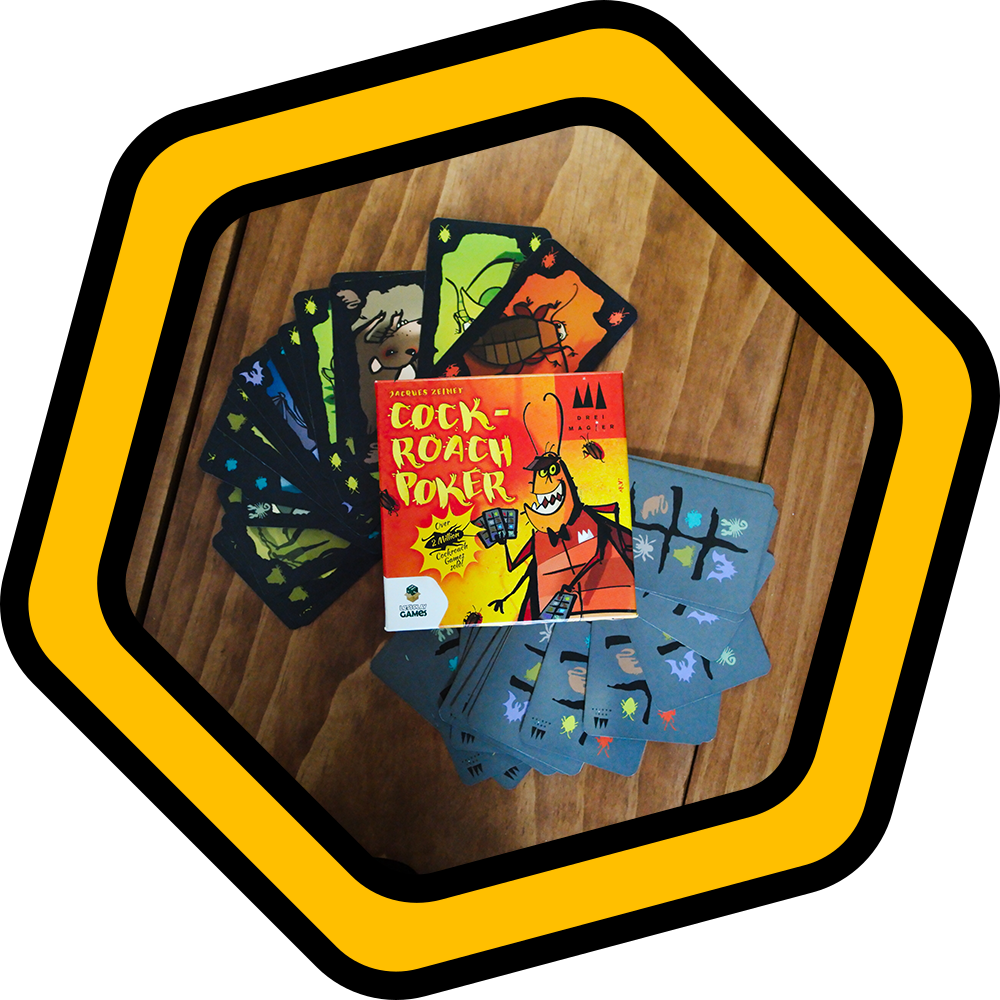
An opportunity to weigh my years of experience with a gang of lovely people, against their ability to be devious for the sake of a memorable time. I feel that no game distils that feeling to its purest essence better than Cockroach Poker, a bluffing card game with rules so simple a coin flip could play it.
How does it work?
As the ‘board game guy’ of my group, rulebooks are often the bane of my existence. Their design has improved a lot over the years but with a handful of people staring at you expectantly from across the table, there can be a lot of pressure to get the explanation over with.
Cockroach Poker’s rulebook fits snugly in the palm of my hand, at a brisk 26 pages. Well, if you’re a hedonistic polyglot. If not, the english rules only account for a mere 6 of those small square pages. If I wanted to summarise these rules any more concisely it would need to be a haiku.
Slide card and declare,
They will believe or doubt you,
Fool them to survive.

Amusing as that was, I don’t think it’s going to revolutionise the rulebook industry any time soon. If you indulged me for about four more haikus I could probably get it, but to summarise less efficiently (and poetically):
- Everyone is dealt an equal share of a shuffled deck, comprised of eight delightfully grimy suits of insects and critters
- On your turn you pick a card, slide it face down to a player of your choice, and make a declaration on which animal it is, truthfully or otherwise
- The receiver then declares whether or not the giver was lying, and the card is then flipped. If the receiver was right, the card goes face-up in front of the giver, but if they were wrong it goes face-up in front of them
- It ends once a player has four of a kind face-up in front of them, rendering them the sole loser of the game
At first glance these rules don’t seem like much. Don’t be fooled, there’s some extra spice on top of this basic formula. For example, there’s actually another option available to you upon receiving a card. Instead of declaring whether or not the giver lied to you, you can glance at the face of the card then slide it to someone else and make your own claim. “Nope, not a Frog, this is a Scorpion. You can trust me on that”.
The strategic catch to this option is that it doesn’t necessarily provide you any safety. You may be free of receivership, but you now take on the giver’s responsibilities and are tasked with continuing or renewing a falsehood. But… if this new receiver were to also glance at the card, and slide it towards another victim, well you’re scot-free baby!
This can be more desirable than it sounds as you can also lose the game if you run out of cards to play, and whoever has to keep the face-up card of a round has to begin the next one. Have you become a tad predictable at your table? Get ready to have five people in a row perfectly call your cards and take you down through attrition.
How does one avoid being read like an open book? Well, everyone has their own form of mental shenanigans to play. Some will plead with you, others will meticulously examine your facial movements, I will try to analyse your card-playing pattern like a student trying to guess their way through a multiple choice quiz. You will feel like a genius or a fool for predicting or defending what is, at the end of the day, a 50/50 choice.

Why does it work?
You would think that its dependency on binary decisions would limit Cockroach Poker’s depth. My friends thought so too. That is, until I had three eye-shadowed rat cards splayed in front of me, and only needed one more to solidify my loss.
Everyone smelled blood in the water and pounced. 50/50 may be a simple choice when the consequences are equal. Now consider the weight of that decision when one of those 50s will be your finale, but you don’t know which. With a single declarative sentence spoken by my opponent, my mind began its mental gymnastics routine trying to ascertain how many levels of double-bluffing may be at play.
He said it was a Frog.
But he knows that a Rat would finish me off.
He’s lying. It’s a Rat masquerading as a Frog.
But he knows that I would be expecting a Rat, which gives him the perfect cover to slide me a Frog, which I already have two of.

He’s telling the truth. It’s a Trojan Frog, full of smaller Frogs which once inside my territory will put me in an even less advantageous situation, a war on both Rodent and Amphibious sides.
But wait, it might not be either a Frog or a Rat. It could be any of the remaining six! There is no benefit in ascertaining exactly which it is beyond potentially bringing more data for mentally calculating the odds of his play. If I say it’s false in the worst case I would only have to take the Frog for now, but if I say it’s true I could potentially lose the game, or be fine in either situation!
Or! I could glance at the card and pawn this whole situation off on someone else!
But! If it is a Rat card, and everyone at this table assumes that it is a Rat card, then their preconceived notions all but guarantee that they’re going to correctly identify it and force it back upon me!
Blast this damned Schrodinger’s Rat!
A choice with the same odds as a coin flip, and yet I sat there spinning my wheels on all of the potentialities of our shared timeline, trying to calculate the winning move. I still lost. It was the funniest way we could’ve ended our dinner party, and we immediately reshuffled and dealt the cards once more.
Cockroach Poker provides a rarity, a high-tension environment full of low-stakes lies, which always ends in a crescendo of laughter and outrage, not to mention a post-game interview with the finalists. Lie to your friends, it’s funny.





Leave a Reply